
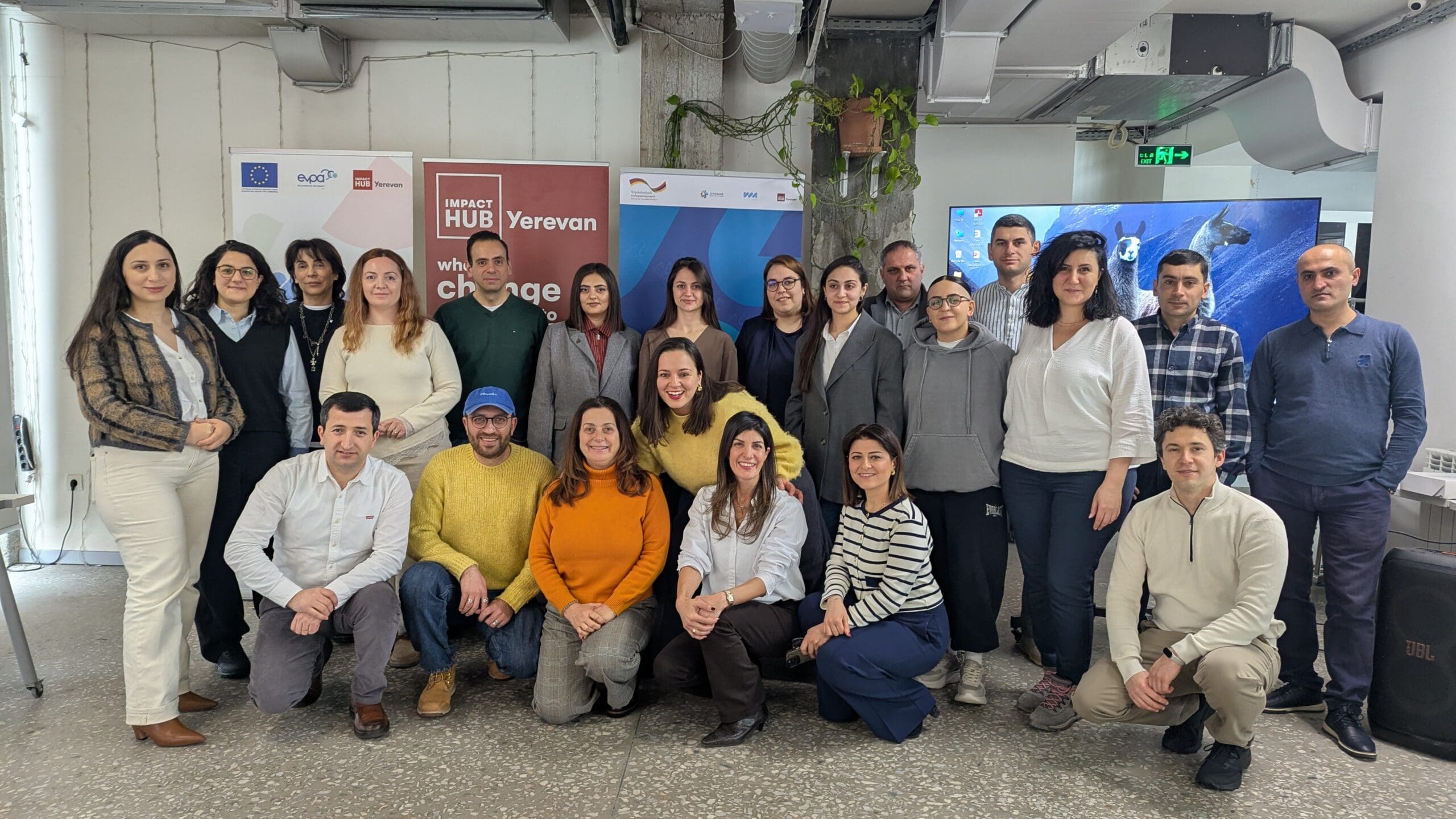
In the wake of forced displacement, the restoration of economic stability has become a matter of systemic reorientation and is no longer a question of granting financial aid. For business owners from Nagorno-Karabakh, the transition to the Armenian market requires a new brand of resilience that puts their operational frameworks under the microscope and into a phase of comprehensive upgrades.
The Digital Empowerment for Enterprises Displaced from Nagorno-Karabakh program was designed to facilitate this specific transition. Supported by the Digital Transformation of Small and Medium-Sized Enterprises in Eastern Partnership Countries (DT4SME), funded by the German Federal Ministry for Economic Cooperation and Development (BMZ), and implemented by GIZ, VIA Fund, and Impact Hub Yerevan, this initiative serves as a strategic bridge between past expertise and future digital sustainability.
The logic of the program rests on the understanding that while physical assets may be lost, intellectual capital and digital infrastructure are portable. The initiative focuses on capacity building, knowledge sharing, and digitalization, structured across two distinct eight-month rounds. By equipping participants with customized workshops and digital resources, the project aimed to help displaced individuals regain economic independence and integrate into the Armenian community.
This business incubator was a specialized response to a unique economic crisis, focusing on businesses that demonstrate a clear history of operation in Artsakh and a willingness to adapt to new regional markets, including Ararat, Kotayk, Lori, Shirak, and Syunik.
The educational journey of the DT4SME workshops began with a focus on the core strategic foundation. Before any digital tools could be implemented, it was essential for entrepreneurs to redefine their value in a new competitive landscape. Nazareth Seferian led these foundational sessions, guiding participants through the Value Proposition Canvas and Business Modeling.
These workshops forced a deep analysis of how products and services originally designed for one market could be recalibrated to meet the specific demands of the Armenian local economy.
By the time the participants reached the sum-up sessions, they had moved from a state of emergency response to a state of strategic planning. As the strategic groundwork was laid, the curriculum shifted toward the mechanics of the digital economy. Gevorg Poghosyan facilitated a series of four intensive modules that served as the backbone of the program’s technical training. These modules moved participants from a basic understanding of online presence to a nuanced grasp of how the digital economy functions in 2025.
This was further enhanced by specialized masterclasses on Artificial Intelligence. Zaven Grigoryan introduced participants to AI tools, demonstrating how automation and generative technologies can act as efficiency multipliers for small teams with limited resources.
The transition from operational theory to market visibility was managed through a rigorous marketing and sales track. Magda Markosyan conducted a multi-part series focused on marketing procurement, and strategic positioning. These sessions were designed to demystify the process of building a brand in a saturated market and, more importantly, how to efficiently source marketing services as a business grows.
Following this, Misha Poghosyan of BalLab focused on Social Media Marketing and SMM procurement. The objective was to move beyond superficial social media usage and toward a data-driven approach where every digital interaction serves a measurable business goal.
The final stage of the customer acquisition funnel was addressed by Narek Aleksanyan, who led three intensive modules on sales and sales procurement. Aleksanyan’s training emphasized that in a digital environment, sales require a blend of psychological insight and systematic follow-through. To support this sales infrastructure, David Ovoyan provided technical depth in Customer Relationship Management (CRM) systems. For businesses attempting to rebuild a customer base from scratch, the ability to track, manage, and analyze customer interactions is the primary differentiator between erratic sales and predictable, sustainable growth.
A business cannot survive on visibility alone; it requires a bedrock of financial literacy and operational discipline. Hrayr Barsumyan led four critical sessions on financial literacy that moved beyond basic bookkeeping.
These workshops focused on the higher-level skills of financial planning, cash flow management, and the fiscal discipline required to maintain an SME during a period of extreme transition.
Recognizing that the leader’s mental clarity is the business’s most important asset, the program also integrated a human-centric component. Lilit Abrahamyan provided life coaching sessions to address the psychological challenges of displacement and the stress of re-establishing a professional identity. This was paired with communication training led by Narine Terzyan, who focused on pitching skills.
The culmination of each eight-month round was a pitching event where participants presented their refined business models and digitalization plans to a panel of judges. The most promising enterprises received direct support in the form of digital tools and resources, facilitating the actual implementation of the strategies developed during the workshops.
Those who completed the curriculum gain access to the Impact Hub Yerevan ecosystem, including a special Alumni Membership. This ensures that the entrepreneurs remain connected to a network of experts, potential investors, and fellow business owners, fostering long-term sustainability well after the formal training has ended.
Ultimately, the DT4SME project was an investment in the intellectual resilience of the Nagorno-Karabakh business community. By focusing on high-level digital transformation and strategic management, the program ensured that these SMEs are not just surviving but are equipped to compete in the modern economy.
Through this curriculum, knowledge became the ultimate asset, allowing displaced entrepreneurs to turn the hardship of the past into a digitally empowered future.